Saint Rupert's Day in Austria
Use our holiday API to get the exact date of Saint Rupert's Day in Austria in every year.
Overview of Saint Rupert's Day in Austria

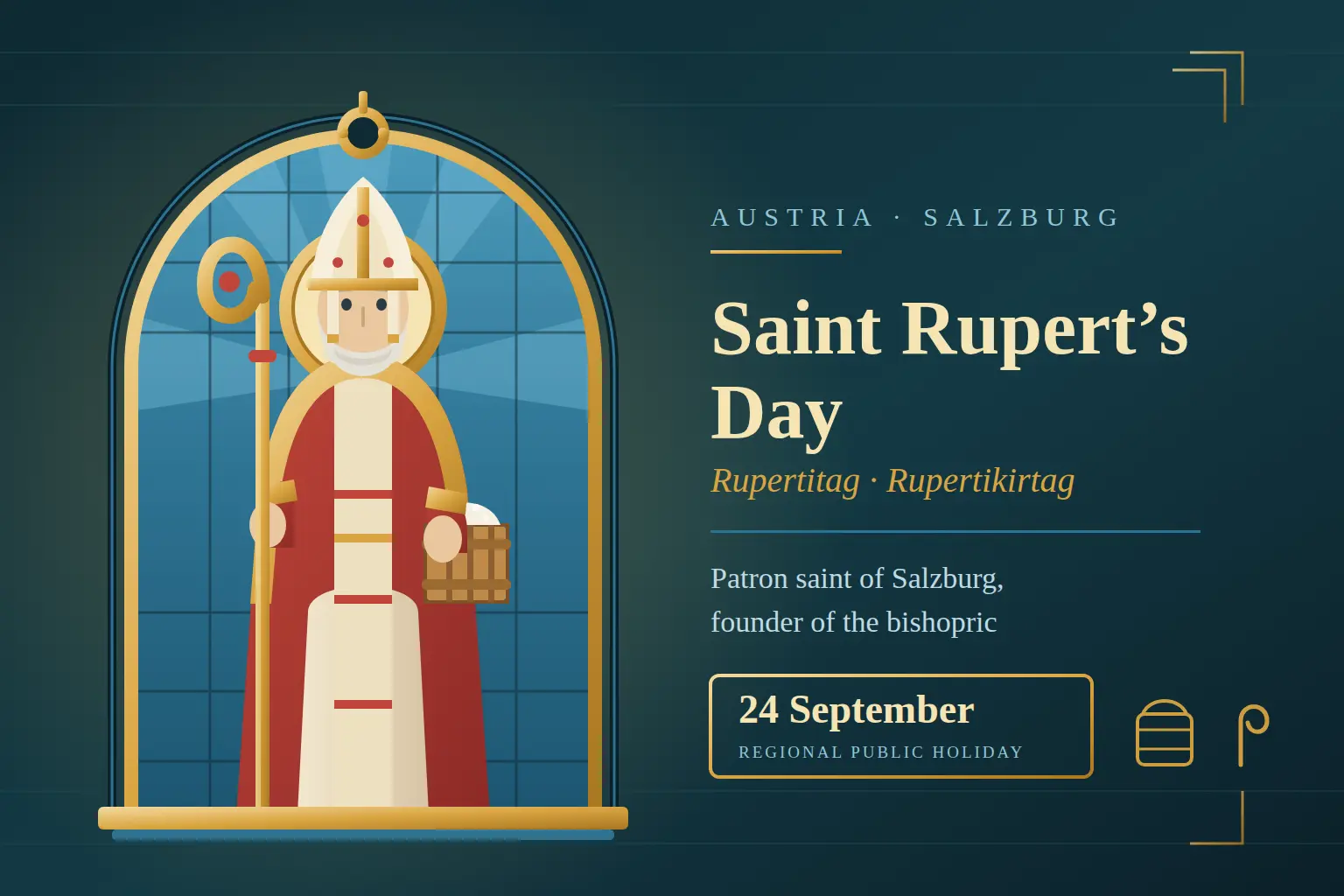
Saint Rupert’s Day (German: Rupertitag or Rupertikirtag) is a regional public holiday in parts of Austria, most prominently in the federal state of Salzburg. It is celebrated annually on September 24 (or the closest weekday in some contexts) in honor of Saint Rupert of Salzburg, the city’s patron saint and the founder of the Salzburg bishopric.
While Saint Rupert’s Day is not a nationwide public holiday across Austria, it plays a major role in the religious, cultural, and civic life of Salzburg and some surrounding areas. The day blends Catholic traditions, folk culture, local markets, and fairground festivities, turning the historic center of Salzburg into a vibrant, colorful celebration.
Who Was Saint Rupert of Salzburg?
To understand the meaning of Saint Rupert’s Day, it helps to know who Saint Rupert was and why he is so important in Austrian, and particularly Salzburg, history.
Saint Rupert: Missionary and City Founder
- Historical period: Late 7th to early 8th century
- Origin: Likely from what is now Germany or France; he was a Frankish bishop
- Role: Missionary bishop, founder of the Bishopric of Salzburg
Saint Rupert is credited with:
- Christianizing the region around present-day Salzburg and Upper Austria
- Choosing the Roman ruins of Juvavum as the base for his new mission, which later became the city of Salzburg
- Founding St. Peter’s Abbey (Stift Sankt Peter) and the Nonnberg Abbey, both key institutions for the spread of Christianity and culture in the region
- Developing salt trade (from which Salzburg, “Salt Fortress” takes its name), contributing to the city’s economic importance
Because of his foundational role, Saint Rupert is widely regarded as the “Apostle of Bavaria and Austria” and as the patron saint of Salzburg and the wider region.
What Does Saint Rupert's Day Commemorate?
Saint Rupert’s Day primarily commemorates the life, missionary work, and legacy of Saint Rupert. Its meaning includes several intertwining layers:
- Religious significance: Honoring a Catholic bishop and saint who helped spread Christianity in the Alps.
- Historical significance: Remembering the origins of Salzburg as a religious, cultural, and economic center.
- Civic and cultural identity: Celebrating the “birthday” of Salzburg as a Christian city and its long-standing traditions, crafts, and rural roots.
In practice, Saint Rupert’s Day functions as:
- A church feast day in the Catholic liturgical calendar
- A local holiday that underlines Salzburg’s unique identity within Austria
- A harvest-season festival, often linked with autumn markets and fairs
When Is Saint Rupert's Day Celebrated?

Fixed Date: 24 September
Saint Rupert’s Day is observed every year on 24 September. This is the traditional feast day of Saint Rupert in the Roman Catholic calendar (note that his death is sometimes dated to the end of March, but local tradition in Salzburg observes him in September).
Holiday Status in Austria
-
Salzburg (federal state):
- 24 September is a regional public holiday in the Land of Salzburg.
- Many employees have the day off, and public life in the city of Salzburg itself is visibly shaped by the celebrations.
-
Other federal states:
- Outside Salzburg, Saint Rupert’s Day is generally not a public holiday.
- Normal working hours and school schedules usually apply in Vienna, Tyrol, Styria, and other states.
The Rupertikirtag: Multi-Day Festivities
The best-known celebration associated with Saint Rupert’s Day is the Rupertikirtag in the city of Salzburg, often extending over several days around 24 September.
Typically:
- The fair and markets run for 4–5 days, often covering the weekend closest to 24 September.
- Activities peak on and around the actual feast day, but weekday evenings also see strong attendance.
How Saint Rupert's Day Is Celebrated in Austria
Saint Rupert’s Day combines church ceremonies, folk traditions, markets, and fairground attractions. While small-scale celebrations and church services occur in various parishes named after Rupert, the epicenter is the historic Old Town of Salzburg.
Religious Observances
On or around 24 September, many Catholic communities hold:
- Festive Masses (Festgottesdienste) in honor of Saint Rupert
- Special liturgical prayers and hymns dedicated to Rupert
- Processions in Salzburg and other places where he is patron
In Salzburg city, you will often find:
- A solemn high mass at Salzburg Cathedral or St. Peter’s Abbey
- Clergy, members of religious orders, and sometimes civic representatives attending in formal attire
- Church bells ringing festively, particularly in the morning
These religious components anchor the day in its original meaning as a saint’s feast.
The Rupertikirtag in Salzburg
The Rupertikirtag is one of Salzburg’s most popular traditional festivals and a central attraction for both locals and visitors.
Location
- Salzburg Old Town, particularly:
- Domplatz (Cathedral Square)
- Residenzplatz
- Adjacent historic streets and squares
These squares are transformed into a large open-air festival area.
Traditional Market and Fair
Elements typically include:
-
Market stalls:
- Regional foods (sausages, pretzels, cheeses, smoked meats)
- Local agricultural products (honey, jams, herbs, schnapps)
- Traditional handicrafts (woodwork, ceramics, textiles, handmade toys)
- Seasonal items and souvenirs related to Saint Rupert and Salzburg
-
Fairground rides:
- Antique or old-style carousels and swings
- Ferris wheel, children’s rides
- Classic fair attractions adapted to the historical setting
-
Food & drink stands:
- Local beers from Salzburg and surrounding regions
- Sturm (young wine in the autumn season), must, and other seasonal drinks
- Grilled specialties, roasted chestnuts, sweet pastries, and regional desserts
The combination of medieval architecture and festive stalls gives Rupertikirtag a distinctive atmosphere that many visitors consider particularly authentic.
Folk Culture and Music
Saint Rupert’s Day celebrations highlight Austrian folk culture:
-
Live folk music:
- Traditional brass bands and Blasmusik
- Folk ensembles playing alpine music
- Occasional performances by choirs or regional groups
-
Traditional clothing:
- Many locals wear Dirndl (women) and Lederhosen (men)
- Folk costumes from different valleys and regions in Salzburg and neighboring areas
-
Dances and performances:
- Folk dances performed on small stages or open squares
- Sometimes traditional shows like Schuhplattler (alpine slap dance) or regional variations
Children’s and Family Activities
Because Saint Rupert’s Day/ Rupertikirtag is a family event, there are usually:
- Children’s rides and games
- Educational displays about rural life or old crafts
- Hands-on activities like trying simple handiwork or learning about local farming traditions
Are Banks, Schools, and Museums Open on Saint Rupert’s Day?
The status of public institutions on Saint Rupert’s Day depends heavily on whether you are in Salzburg or another Austrian state.
Banks
-
In the Land of Salzburg (especially Salzburg city):
- Saint Rupert’s Day is a regional public holiday.
- Banks are generally closed on 24 September.
- ATMs remain accessible, as usual.
-
Outside Salzburg:
- Bank branches are usually open, as 24 September is a normal working day in most of Austria.
Schools
-
In the Land of Salzburg:
- Many schools are closed on 24 September due to the regional holiday.
- In some cases, special school-related events or excursions might be tied to the Rupertikirtag on the days before or after the holiday.
-
In other Austrian states:
- Regular school activities continue.
- There may be no official reflection of Saint Rupert’s Day in the school calendar.
Public Offices and Businesses
- Public administration in Salzburg (state and municipal offices) is usually closed or operates in limited capacity.
- Many local businesses in Salzburg may:
- Close for the day, or
- Operate on holiday or reduced hours, especially in the immediate Old Town which is focused on the festival.
Tourism-oriented businesses (restaurants, cafés, souvenir shops) in and around the Old Town typically remain open and busy, as Saint Rupert’s Day is an important date in Salzburg’s tourism season.
Museums and Tourist Attractions
-
Most museums and tourist sites in Salzburg, such as:
- Hohensalzburg Fortress
- Salzburg Museum
- Other major cultural sites
are often open on Saint Rupert’s Day, sometimes with special programs or extended opening hours due to the surge in visitors.
-
However, opening hours can vary, and some smaller institutions may close or adjust schedules. It is advisable to check the specific museum’s website or contact them directly when planning a visit on or around 24 September.
History of Saint Rupert’s Day and How It Became a Holiday
Early Veneration of Saint Rupert
After Saint Rupert’s death (traditionally dated to the early 8th century), his cult spread across the region:
- His remains and major relics became important pilgrimage attractions in Salzburg.
- Local monasteries promoted and preserved his legacy through chronicles and liturgical texts.
- Rupert’s memory was closely tied to the emergence of Salzburg as an ecclesiastical principality.
By the Middle Ages, 24 September had become firmly established in the regional liturgical calendar as the Feast of Saint Rupert.
Development of the Kirtag Tradition
The German word “Kirtag” (Kirchtag, Kirchweih) refers to a church dedication festival or patron saint’s day celebration held in the parish.
Over time:
- Rupert’s feast day evolved from a purely religious celebration into a local market and fair.
- Rural populations and city dwellers began to gather on this day in Salzburg:
- To attend mass
- To conduct trade, sell regional goods, and meet friends or relatives
- To enjoy music, food, and performances
This combination of holy day and market day is typical of many European towns, but in Salzburg, it gained particular prominence due to the city’s status as a spiritual and trade center.
From Church Feast to Regional Holiday
With the secularization processes and state reforms in the 18th and 19th centuries, many religious feast days were reassessed. However, Saint Rupert’s Day remained important due to:
- The strong identification of Salzburg with its founding saint
- The economic and social significance of the Rupertikirtag
- The cultural value of the annual autumn fair
Ultimately, Land Salzburg recognized 24 September as an official regional public holiday, maintaining the link between:
- Historic tradition
- Religious heritage
- Modern civic identity
The continuation and further professionalization of Rupertikirtag in the 20th and 21st centuries turned it into:
- A major tourist attraction
- A showcase of regional culture, crafts, and gastronomy
- One of the most recognizable public holidays in Salzburg’s calendar
Practical Tips for Experiencing Saint Rupert’s Day
For travelers and residents planning to experience Saint Rupert’s Day in Austria, especially in Salzburg:
-
Book accommodation early
- Rupertikirtag attracts many visitors; hotels in Salzburg’s center can fill up quickly around 24 September.
-
Check public transport and parking
- Parts of the Old Town may be closed to cars or have restricted access.
- It’s often easiest to use public transport or stay within walking distance of the center.
-
Verify opening hours
- If you intend to visit museums or specific attractions, check their schedules for 24 September, as they can differ from normal days.
-
Bring cash
- Many stalls accept cards, but some small vendors may still prefer or require cash.
-
Wear comfortable shoes
- You will likely spend several hours walking or standing in the Old Town streets and squares.
-
Consider traditional dress
- If you own or plan to acquire a Dirndl or Lederhosen, this event is an ideal opportunity to wear them and fully immerse yourself in local culture.
Summary: The Significance of Saint Rupert’s Day in Austria
Saint Rupert’s Day is a regional yet highly significant public holiday in Austria, centered on the Land of Salzburg and its capital city. Observed on 24 September, it honors Saint Rupert, the missionary bishop who founded Salzburg as a Christian and economic center.
The day is marked by:
- Religious ceremonies and church services
- The extensive Rupertikirtag festival, featuring markets, rides, music, and regional specialties
- The closure of banks, many offices, and schools in Salzburg
- Lively participation by locals and visitors, many in traditional dress
For anyone interested in Austrian public holidays, local traditions, or the cultural life of Salzburg, Saint Rupert’s Day offers a rich, authentic, and multifaceted experience that bridges past and present in one of Europe’s most picturesque cities.